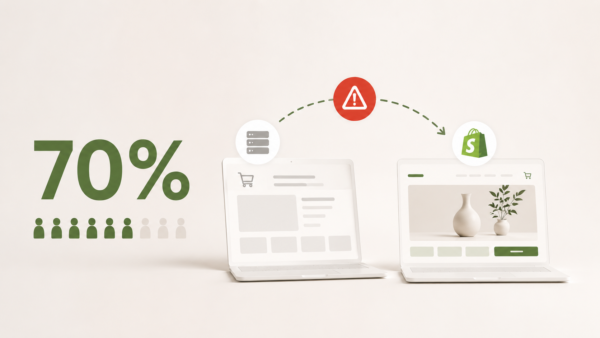

Scaling an online store is, to a large extent, an architecture problem.
Many e-commerce businesses grow in catalog, traffic, and orders, but their technical foundation does not grow at the same pace. At some point, that gap begins to limit what is possible: integrations that do not work properly, response times that increase, systems that do not communicate with each other.
It is not that something fails dramatically. It is that the system was designed for a size that has already been exceeded.
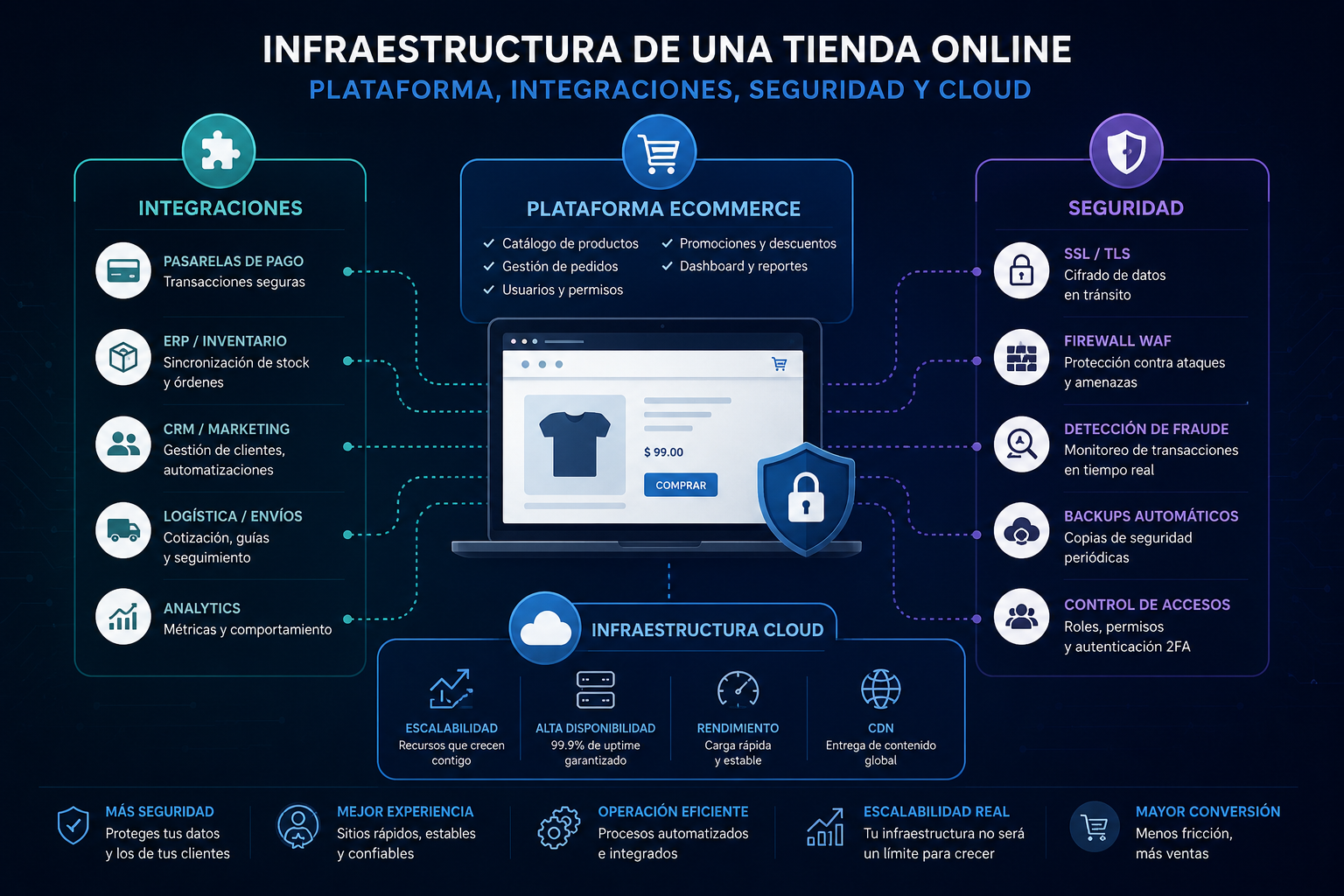
📍 Technical infrastructure in e-commerce: the set of systems, servers, integrations, and security configurations on which an online store runs. When properly designed, it sustains growth. When not, it slows it down.
What changes when the business grows faster than its technical foundation.
When an e-commerce team plans its year, the natural focus is on product, logistics, and advertising. Technical infrastructure is the context in which all of that operates, but it rarely appears in the budget with the same clarity.
This is not an oversight: it is a consequence of how most digital projects are built. You start with the minimum necessary to function, and adjust as you go.
The problem appears when adjustments are no longer enough.
An online store that grows accumulates technical complexity: more integrations between systems, more customer data to manage, more sales channels to coordinate. According to the Cost of a Data Breach Report 2024 by IBM, organizations that do not have visibility over their attack surface take an average of 258 days to detect a breach. For an e-commerce operation, that time is operation at risk without knowing it.
Cybersecurity, in this context, is not an IT issue separate from the business. It is part of the decision of how to build the system on which the store grows.
With or without solid infrastructure? What changes in practice.
The difference between a store that scales with control and one that scales with friction is not always visible from the outside. But the team feels it in day-to-day operations.
| Without planned technical foundation | With architecture designed to grow | |
| High traffic | Instability during key seasons | Scaling without impact on operations |
| Integrations | Manual or error-prone synchronization | Automated and documented flow |
| Security | Reactive reviews after an event | Continuous monitoring and preventive patches |
| Product changes | Costly because the code is difficult to modify | Rapid iterations with lower risk |
| Visibility | The team learns about problems from customers | Internal alerts before the customer notices |
In a recent project, Yourdevs developed an MVP on Azure to centralize quotes, orders, and customer history for an auto parts client. The starting point was not “what technology to use,” but “how does the business work today and what does it need to operate better.” That distinction is what defines whether a technical solution scales or whether it needs to be rebuilt in six months.
When and how cybersecurity enters an e-commerce project.
Cybersecurity is not a phase of the project. It is a perspective that runs through all the others.
That distinction changes how decisions are made from the start: what data is stored and how, what access is configured, how integrations with third parties are managed. These are not abstract security questions: they are business questions with technical consequences.
| 📍 According to the European Union Agency for Cybersecurity (ENISA), more than 60% of vulnerabilities exploited in enterprise systems corresponded to known flaws that already had an available solution. The challenge was not technological: it was management and visibility. |
In Chile, Law 21.719 on personal data protection comes into effect in December 2026. For stores operating in the Chilean market, the framework is already defined: what is appropriate now is to review how customer data is stored and processed, and adjust where necessary.
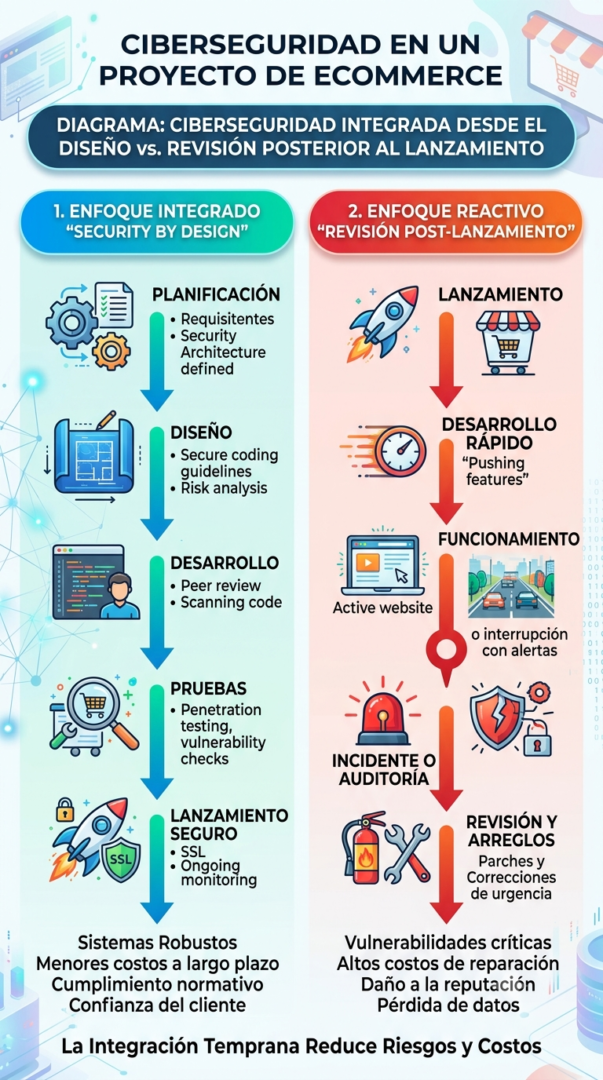
When security is considered from the architecture, the cost of implementing it is low and its impact, sustained. When it is reviewed after an incident or external audit, the cost is higher and the room for maneuver, lower.
A security audit or penetration testing on the store’s infrastructure are not projects for when the company “is large.” They are diagnostic exercises that allow you to operate with more information about the actual state of the system.
Yourdevs: diagnosis, architecture, and integration as a single process.

Yourdevs is a Chilean technical studio that works with companies in Chile and LATAM in software development, cybersecurity, and cloud. What distinguishes them is not the service catalog, but the way they approach each project.
The process begins by understanding how the business works today: what systems are in use, how they connect, where there is friction, and what technical decisions were made in the past that should be reviewed. From there, what needs to be changed, what can be optimized, and what should be built from scratch is defined.
The team that performs that diagnosis is the same team that then implements. There is no commercial layer that translates requirements to a different technical team: continuity in judgment is part of the model.
This has a direct impact on results. In the case of Fastparts, the solution that Yourdevs built on Azure was not the first item on a list of deliverables: it was the conclusion of an analysis process on how the business managed quotes, orders, and customer history, and what needed to change for that process to be scalable.
For an online store that wants to grow with more control over its technical foundation, the first step is to have clarity on where it stands. Yourdevs offers an initial diagnosis without commitment, focused on understanding the system before proposing any solution.